Octopodes.jl - Joint exoplanet modelling
Getting started
Basic usage:
using Octopodes, Random

dict = Octopodes.Examples.small_dict()
runs = IndepRuns(dict)
b = Binning(runs, n_log_P_yr_intervals = 20, n_log_q_intervals = 20)
binned = bin(b, runs)
result = run_imh(Xoshiro(1), binned);
typeof(result)
@NamedTuple{psi_trace::Matrix{Float64}, pi_trace::Matrix{Float64}, states_trace::Matrix{Octopodes.BinnedSample{UInt8, Tuple{UInt16, UInt16, UInt16}, UInt32}}, accept_prs::Vector{Float64}, binning::Binning{StepRangeLen{Float64, Base.TwicePrecision{Float64}, Base.TwicePrecision{Float64}, Int64}, Tuple{Int64, Int64}}}Summarize the joint-π posterior (warmup drop, per-bin rate density b, so they never have to be passed by hand:
fig = population_posterior_plot(result; warmup_frac = 0.2)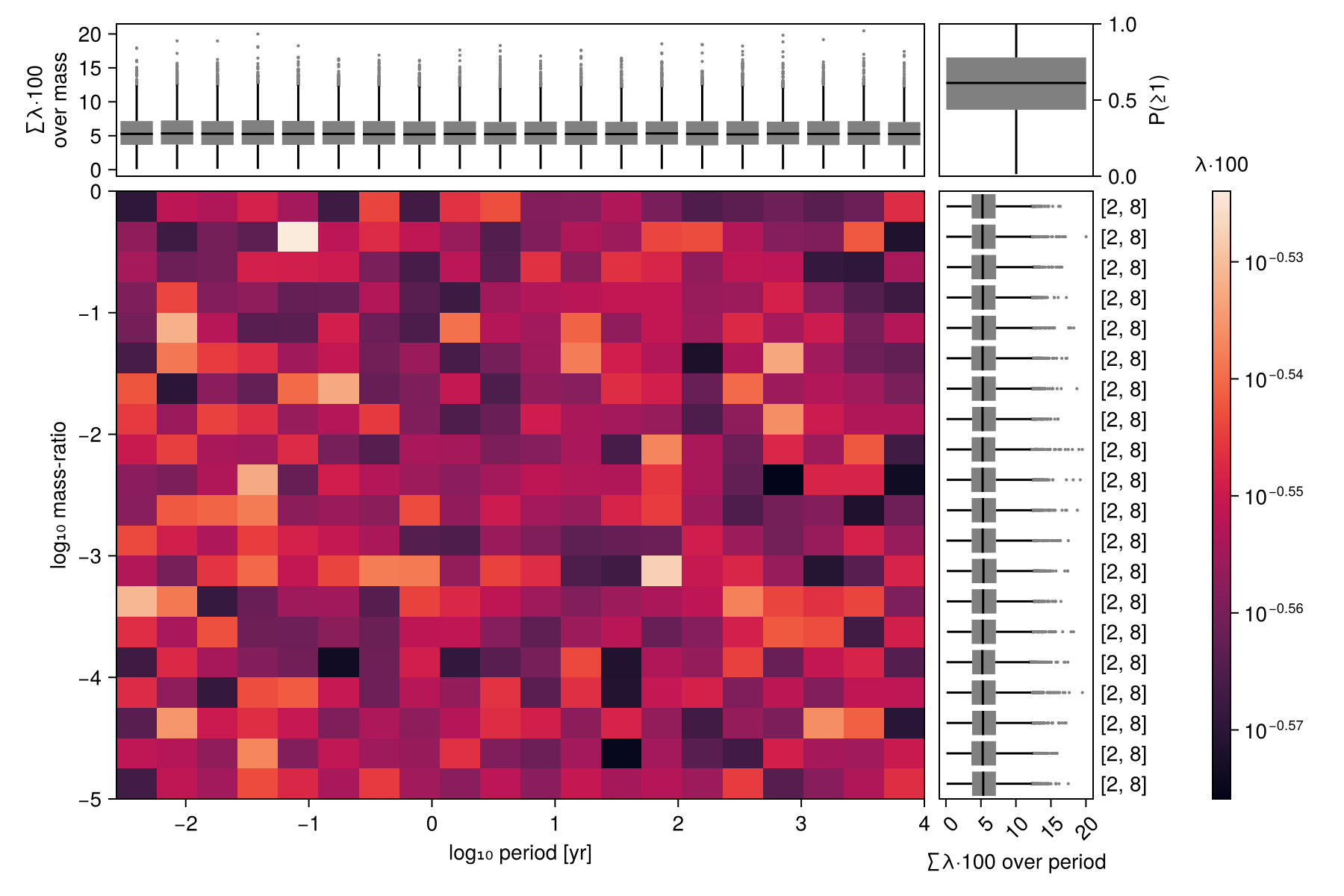
If you also want the summarized quantities, build the PopulationPosterior explicitly and plot that:
post = population_posterior(result; warmup_frac = 0.2)
post.lambda   # n_keep × n_log_P × n_log_q  (E[n]·π per bin)
post.P_geq    # max_n_companions × n_keep   (P(n ≥ c))
fig = population_posterior_plot(post)
Bins whose posterior is driven by the prior rather than the data can be masked out using the per-bin relative prior-sensitivity. Masked bins are blanked on the heatmap and dropped from the marginal sums:
sens = relative_sensitivities(binned, 1e-3)
fig = population_posterior_plot(post; sensitivity = sens, sensitivity_threshold = 2.0)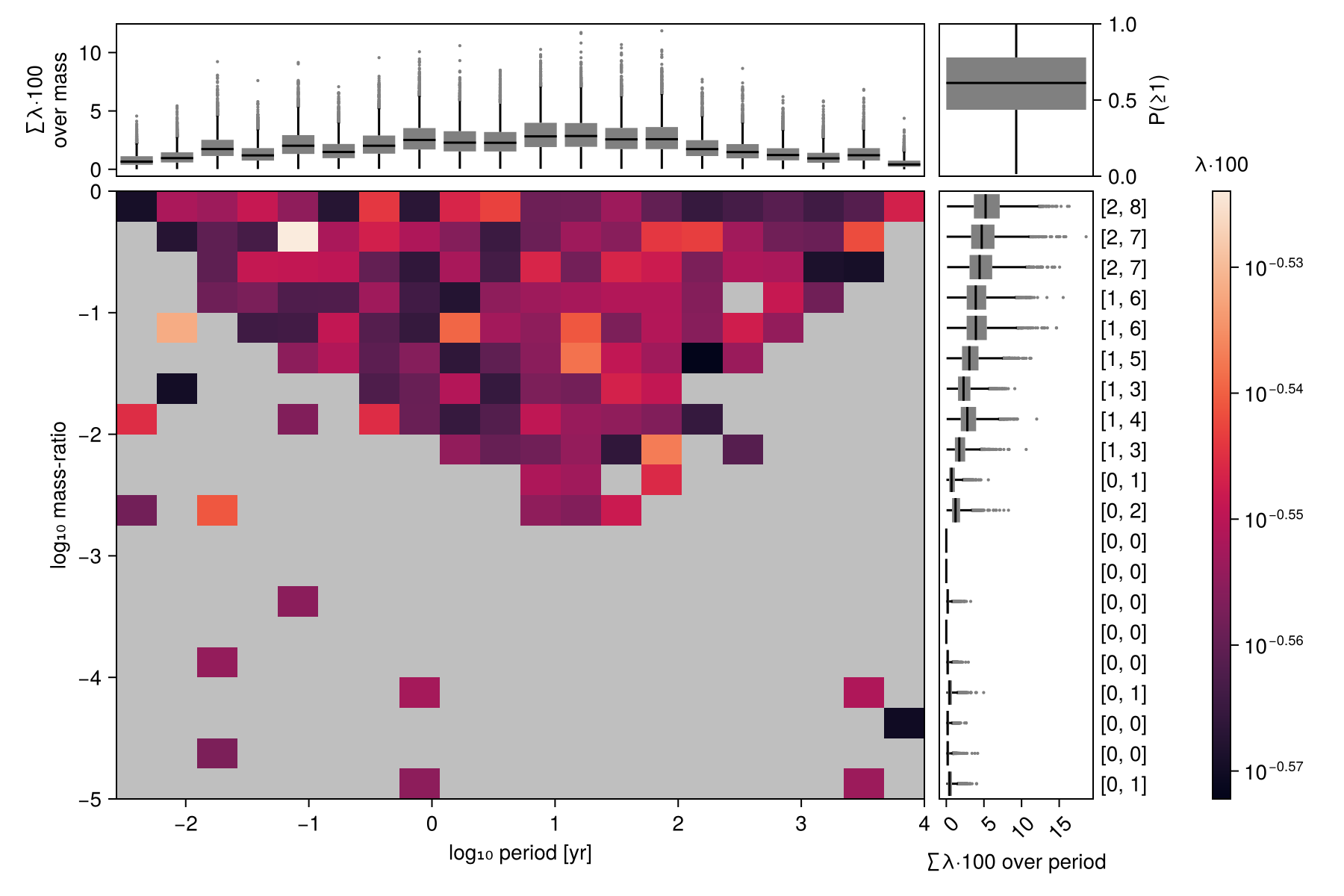
How to generate/preview doc
Use include("docs/preview.jl") or include("docs/make.jl").
How to develop
JET and Revise need to be in sync, so use the following to start Julia: ./dev.sh This will load the Test environment. Run individual tests with e.g., include("test/test_imh.jl).
This page was generated using Literate.jl.